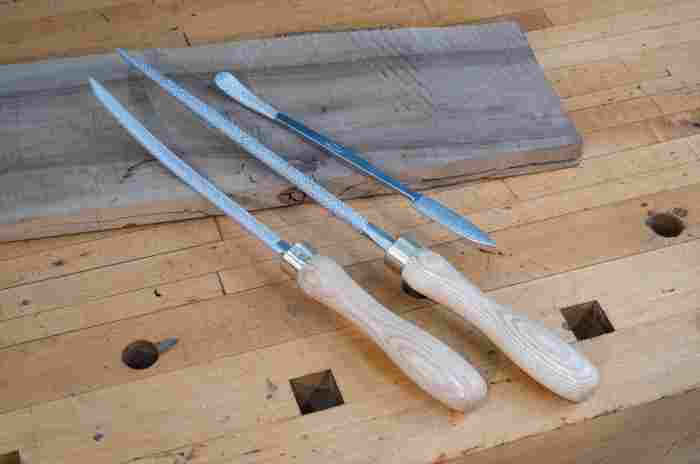
Months after we first showed our new 14" sash saw at Woodworking in America last October I can finally say we have the first batch of saws done. Above is a bunch being laid out for final testing and inspection. Testing these saws is pretty involved because these saws are filed so that you can use them either for ripping or crosscutting. So we have to test them in both configurations. It takes time.
The reason for this fairly complicated filing (5° negative rake, 7° fleam) is because we learned for several historical sources including the Joiner and Cabinet Maker that a single sash saw was the general go-to all-purpose joinery saw of the early 19th century. You might think that this type of filing would be pretty harsh in use but like most hand filed saws (and the saw is of course hammer set and hand filed) the action is pretty sweet, especially as the saw breaks in.
I'll have more details and more background information and some sample pictures of the quality of the cut when we officially announce the saw - probably next week (I need to take a decent picture of the saw first). At the same time we will add it to the website for ordering. I can tell you that the introductory price will be $219.95 for the first month with the regular price after that being $239.95.
For those of you who placed an order at Woodworking in America we will of course charge you the introductory price.
ps - the coding on the brown paper in the picture is the way we keep track of which tests have been on each blade.
Before I was an iron monger I did a lot of things including fine art photography. I had a few exhibits but I never sold enough to make a living at it. It was an important creative outlet for me. Most of the photography I do for TFWW is commercial and directed to show a specific product or technique. So please indulge me for a few seconds. Here is a picture I took purely because I liked the image.
If you like this image please let me know and I will post some more.
After a mention in Chris Schwarz's blog we had a big rush on 18tpi coping saw blades. So we ran out. We buy them in bulk and repackage them in dozens. It's a lot of mundane work. With just about everyone working flat out on other equally important stuff I realized that if I didn't repackage the blades myself they would not get done for days. So whenever I feel I don't have the patience or will to start a new task I pack a bunch of blades. It's easy work but the blades are entangled in the bulk packages and your hands get scratched up. After a few hundred dozen you get pretty good at counting to twelve.
The best part of doing this is that it gives me a chance to think and I realized this is what our ancestors meant about idle hands. Not every job we do is hard, skilled, or even interesting. But lots of little jobs need patience and reliability. The time to do them is when you need a break. Once I am in the flow it's pretty relaxing to do it. Apparently there is even some scientific research that suggests that repetitive mundane tasks like this lower you levels of stress. There is also a great sense of accomplishment because it's a task that nobody really has the time for or really loves to do. But it must be done if we are going to fill orders. And it's certainly more useful than pretending I am working by surfing the Internet.
How does this pertain to woodworking? Take a look at the annoying tasks you do. Like putting things away in the shop. Cleaning. Try to look at them not as a chore at the end of the day, but a useful, relaxing diversion while you collect your thoughts for the next good job. And what's really key is that as long as you don't seethe at the annoyance of doing the task while you do it, it really will be a "useful, relaxing diversion while you collect your thoughts for the next good job".
Up until a couple of weeks ago, when Chris got his copy, I was possibly the only person on the planet with a leather bound version of The Joiner and Cabinet Maker. My copy is from 1845 or so and has seen better days. The original book was cost a shilling in a cheap paper binding, and Charles Knight, the publisher, really believed in inexpensive books that were affordable to anyone. While that's an admirable goal - which I certainly agree with, you can't beat a leather binding for "hand feel" and a sense of history.
We took some extra copies that were not bound at the printer and had a custom binder bind 26 copies, one for each letter of the alphabet, in leather, signed by both Chris Schwarz and myself, with a sleeve glued in the back for the included DVD. I should mention that after signing all 26 copies I got a chance to compare my signature to Chris's. As you can see in the photo Chris signs his name with sure, angular lines, as befitting an accomplished writer and editor. My signature is rounder, more juvenile, you can sort of picture me signing carefully with intense focus and my tongue handing out - which is not far from the truth. And of course while Chris's handwriting demonstrates fluency, my handwriting telegraphs surprise that I seem to know ALL the letters. But fortunately Chris assigned the letter sequence to the books so my fluency isn't being tested.
You can read a lot more about the edition here on the Lost Arts Press website, and about the bindery here.
As it happens when Chris first announced that these books would be available we got enough inquiries so we are largely sold out of this edition. I regret I didn't post this blog entry earlier but with the holidays I have been both swamped and exhausted, and have neglected the blog for a few weeks. Also I didn't have the books until yesterday. We probably should have used a language with a larger alphabet but as of now we are basically sold out. Send me an email if you are interested and I will look around. Regular, cloth bound editions are of course available here and as always I am happy to inscribe your copy if you wish.
I don't know. Really, I don't. I get asked this question at least three times a week and for someone like me who pretends to know everything it's really frustrating to tell people that I don't have a clue.
I don't. Here's why:
How the color of the dye is perceived works is a function of the color of the dye, the strength (dilution) of the dye, the underlying color of the wood underneath it, the texture of the wood and how the sheen of the wood reflects light, the color of the topcoat over the dye, the lighting on the piece, and the color of the piece next to the dyed piece. I might have left out a few criteria but that's the gist of it. Look at the following examples:
All the examples use the same walnut dye at the same strength. Of course you can vary the strength of the dye and the intensity of the color just by diluting the dye.
Same dye, same strength, on two different types of bare wood (poplar and pine)
Same dye, Same strength, on poplar. Top coated with blond shellac on the left, no topcoat on the right.
The previous samples were photographed under natural sunlight near a window. This picture is of the same wood but under regular fluorescent lighting.
Here is a walnut stain sample surrounded by a dark or light border.
Do you see what I mean.
In part two (which may or may not be the next blog entry) I'll talk about things I discuss when in spite of my ignorance I try to help people get the
color dye they want.
Note: Due to the way I like to photograph things the pictures are redder than they are in real life.
I found out today that Roy Arnold passed away. I never met the gentleman - the only conversation I ever had with him was about credit card information for a book I ordered from him - and yet I feel his loss.
Roy Arnold was one of the most important pioneers in tool collecting and an early important dealer in tools. But the most important thing he did was encourage scholarship in the world of tools. He published a huge number of very important, seminal works on tool collecting. He published the works of Bill Goodman - ("British Planemakers From 1700," to name one title) He published the works of Mark and Jane Rees ("Tools: a Guide for Collectors" - such an important book, and one of many ). He reprinted numerous catalogs that today in our shop we refer to constantly in our quest to reintroduce tools from the early 19th century.
Above is the cover of Catalog #1 from 1974. Roy Arnold and his partner Phillip Walker didn't just want to sell tools, they also wanted to educate people as to why the tools they sold were interesting and historically important. Their focus wasn't buying used tools on the cheap to help mend the shed, but rather tools as historical markers of our industrial societies and as masterpieces of art and craft. Below is a scan of a page of the catalog (click on the image to enlarge it). You can see how much effort has gone into explaining the significance of each tool. When I was starting out, I learned tons from reading these pages. Since then, prices have gone up a lot, but I think Roy would be very proud that his encouragement of more research has made many of his descriptions obsolete, as new findings have taught us lots more.
Our condolences go out to Roy Arnold's family, and I hope that they gain comfort in the knowledge that the work that he started - learning and educating others about tools - continues forward.
There is a big market in marking tools and no consensus what they should look like. Pointy, straight, single beveled, double beveled. thin, thick, it's a jungle out there. However, except for one not so common case the geometry of the layout tool really isn't important as long as you use the tool correctly. The correct way to do it is to bring the straightedge or square to the layout tool not the other way around. In this example I am using an awl. It has a thick body that comes to a point. Look how I am doing this. First I am putting the awl on the spot I want my line. Then I am sliding the square until it contacts the awl.
Then I scribe the line I need.
The point is that by sliding the square to meet the awl it doesn't really matter how thick or thin the layout tool is. As long the square touches the awl I will get a perfect line in the correct place. If I did the reverse, which is a common mistake, and placed the square where my mark was and THEN put down my awl, I would have to worry how much space I needed for the thickness of the awl. And if instead I used a single bevel layout knife with the flat bearing on the square I would easily, very easily, cut into and damage my square. Even tilting an awl so its point is right next to the square is a good way do damage a square and isn't as reliable a method as just moving the square to the awl.
Like any technique or habit it just takes paying attention a few times to it and then the skill will become automatic.
The special case is tracing the pins or tales of a dovetail to the opposing piece or some other tracing operation. In that case you need to tilt the tool so that it really scribes an outline, not a little bigger. For most dovetails, this isn't a problem but for really thin pins you just don't have clearance to tilt an awl. In that case a very thin, single bevel layout knife is your best bet. Even if you do accidentally cut into the piece you are scribing from, it's a one shot and not like permanently damaging a square which you use all the time.
With the holiday rush over and done I want to thank everyone for their support and wish all of you a happy and healthy holiday season and new year. It's been a tough year for lots and lots of people and I hope next year is better all around.
Last Tuesday FedEx didn't pick up on time and Chrystil went downstairs to babysit our shipments because the elevator closes at 5:00. At 5:40 I took over and spent the next 40 minutes on the phone wondering where the truck was in a standing in a dark freezing lobby. It was very boring and very cold. A nice young lady who works in the neighborhood stopped by and offered me a French polish, which I declined, and I amused myself instead by taking the picture you see above. It's the scene in front of our building, looking towards the harbor, a lonely desolate night. The scene does offer hope, for deep in the distance, on this icy but clear evening, you can see the Statue of Liberty lit up, with her torch held high, welcoming all to America and its promises of the future. I took the photo with my phone so it's kind of lo-res but here is a blow up the of part were you can see the statue in the distance. .
Merry Christmas, Happy Holidays, and a Happy and Healthy New Year To All.
Thanks again,
Joel and everyone at Tools for Working Wood.
ps - I'll be back to real woodworking topics on my next blog post!
First of all I got some interesting comments from Peter Follansbee on early mentions of shellac which suggest I'm all wrong. I got my dates screwed up. Here's the gist of what he says:
"Have you seen John Stalker & George Parker, A Treatise of Japanning and Varnishing (London & Oxford, 1688)
I don't have a copy, but have read excerpts; the best treatment is in Adam Bowett, English Furniture 1660-1714 From Charles II to Queen Anne (Antique Collectors Club, 2002).
I think it's the earliest descriptions of the use of various lac-based finishes, seed, shell and sandarac. Evelyn's Sylva (1664?) might mention shellac; but no description of its use...
I don't use these finishes; they haven't been identified in any studies/analysis of the more pedestrian furniture of early New England. This stuff is really high-brow in English work...
Bowett's book is excellent, great treatment of the style & construction of the period, but not the simple oak stuff..."
In other shellac news we have had tremendous problems first with shellac flakes caking up and then in some cases not dissolving. So we took all our shellac out of inventory until we could figure out what is wrong. Many phone calls and some practical testing later here is what we came up with:
When you heat up shellac and add humidity it starts polymerizing. What that means practically is that it won't dissolve.
Our shellac is shipped from overseas (India and Germany) in refrigerated containers. We repackage the shellac into plastic canisters which should have been air tight but turned out not to be. Then we store it in our largely unheated and uncooled warehouse.
During the fall, winter, and spring everything is fine. The screw top canisters while not air tight are fairly tight, and the temperature is ok. Then came last summer. It was really hot and the shellac fused in the bottles.
We tested the fused stuff and it dissolves no problem. But I think the longer it sits there the worse it can get. So we started getting complaints. Some from people who just didn't like the fused shellac and others who could not make it dissolve. At the time we didn't know why but since we do now we are taking the following steps:
Tossing all the shellac we have that is old / fused - unless we can test the canister and see that it's ok.
Starting again from fresh stuff.
Go back to sealed plastic bags until we can find a canister that's really air tight.
Get a refrigerator or something for summer shellac storage.
The garnet shellac we have is very very fresh. We have fresh amber that needs packing and we will get new blond and super blond in early January.
We are also tweaking our packing process to lower costs and to keep the increased storage costs from causing us to have to raise pricing - which we don't foresee now.
By the way the German shellac we stock has such large flakes that breaking up the flakes before adding alcohol speeds the dissolving process.